A Structured Guide to Quantum Computing Skills and Professional Readiness
1. Introduction
Quantum computing is creating new opportunities in software development, cloud engineering, scientific research, and technology architecture. It uses quantum principles to process information differently from traditional computers.
However, learning quantum computing requires more than theoretical knowledge. Professionals need mathematics, programming, circuit development, algorithm understanding, and practical experience. They must also understand the limitations of current quantum hardware.
A structured learning plan helps professionals develop these skills in the right order. Beginners can start with basic concepts, while experienced developers can focus on programming and cloud execution. Architects and managers can explore system design, project planning, and technology evaluation.
This guide explains ten important quantum computing topics. Each section covers its meaning, important skills, detailed learning steps, practical exercises, and professional applications.
2. Identify Your Starting Point Before Learning Quantum Computing
Every learner has a different technical background. Some people know Python, while others have experience with cloud infrastructure, software architecture, or project management.
Start by evaluating your existing knowledge.
2.1 Beginner Level
Beginners should focus on:
- Basic mathematics.
- Classical and quantum computing differences.
- Qubits and quantum states.
- Superposition and entanglement.
- Quantum gates.
- Basic Python programming.
The goal is to understand the language and fundamental concepts of quantum computing.
2.2 Intermediate Level
Learners with programming experience should study:
- Quantum circuit creation.
- Programming frameworks.
- Simulator execution.
- Circuit measurement.
- Transpilation.
- Basic quantum algorithms.
- Cloud-based experiments.
The goal is to develop and test simple quantum applications.
2.3 Advanced Professional Level
Experienced technical professionals can explore:
- Quantum system architecture.
- Physical hardware constraints.
- Hybrid computing.
- Algorithm optimisation.
- Error correction.
- Cloud integration.
- Technical feasibility assessment.
- Project governance.
The goal is to evaluate complex workflows and understand how quantum technology fits into larger systems.
3. Ten Important Quantum Computing Keywords Explained in Detail
3.1 quantum cloud computing training
3.1.1 What Is Quantum Cloud Computing Training?
Quantum cloud computing training teaches professionals how to use remote quantum computing resources through cloud-based environments.
It combines quantum programming knowledge with cloud infrastructure skills. Learners understand how to prepare circuits, select computing resources, submit tasks, monitor execution, and collect results.
Cloud access makes quantum experimentation more accessible. Users can work with available simulators and supported quantum hardware without owning specialised equipment.
3.1.2 What Skills Should You Learn?
A detailed learning programme should cover:
- Cloud computing fundamentals.
- Quantum computing principles.
- Quantum programming environments.
- Circuit creation and testing.
- Simulator configuration.
- Cloud authentication.
- Access permissions.
- Quantum task submission.
- Execution monitoring.
- Results collection.
- Cloud resource management.
- Hybrid quantum-classical workloads.
3.1.3 Step-by-Step Learning Process
Step 1: Understand cloud infrastructure.
Learn how cloud accounts, regions, storage, permissions, and remote computing resources work.
Step 2: Learn quantum computing basics.
Understand qubits, gates, quantum states, superposition, entanglement, and measurement.
Step 3: Prepare your programming environment.
Install Python and create a separate development environment for quantum programming.
Step 4: Choose a programming framework.
Understand how a framework represents quantum circuits and operations.
Step 5: Create a basic circuit.
Start with one or two qubits. Apply a few gates and include measurement operations.
Step 6: Run a local simulation.
Test the circuit before submitting it to a cloud environment.
Step 7: Understand authentication.
Learn how approved credentials and access permissions support remote execution.
Step 8: Select an execution resource.
Review the capabilities and availability of supported simulators and quantum devices.
Step 9: Submit a quantum task.
Send your circuit to the selected execution environment.
Step 10: Monitor execution.
Review task status and identify common execution problems.
Step 11: Collect results.
Retrieve the measurement output and save the experiment settings.
Step 12: Evaluate the experiment.
Compare simulator results with available hardware results and document any differences.
3.1.4 Practical Project
Create a two-qubit circuit and test it using an ideal simulator. Then run a supported cloud experiment using the same circuit.
Record the execution environment, circuit configuration, measurement results, and observed differences.
3.1.5 Professional Applications
This knowledge can support cloud engineers, DevOps professionals, software developers, quantum developers, and researchers who work with remote computing environments.
3.1.6 Expected Learning Outcome
You should understand how to prepare a quantum circuit, submit a remote task, monitor execution, retrieve results, and identify cloud-related limitations.
3.2 quantum computing certification course
3.2.1 What Is a Quantum Computing Certification Course?
A quantum computing certification course provides structured education in quantum computing concepts, mathematics, programming, algorithms, and practical experimentation.
It helps learners progress from introductory knowledge to specialised technical topics. Some programmes focus on beginners, while others target developers, architects, researchers, and managers.
A good course should combine theoretical lessons with practical activities and meaningful assessments.
3.2.2 Important Course Modules
A detailed curriculum may include:
- Introduction to classical computing.
- Fundamentals of quantum computing.
- Mathematics and linear algebra.
- Qubits and quantum states.
- Superposition and entanglement.
- Quantum gates and circuits.
- Measurement and probability.
- Quantum programming frameworks.
- Quantum algorithms.
- Simulator development.
- Quantum hardware concepts.
- Cloud execution.
- Hybrid computing.
- Error correction fundamentals.
- Practical projects and assessments.
3.2.3 Step-by-Step Course Selection
Step 1: Define your career objective.
Decide whether you want programming, engineering, architecture, research, or management knowledge.
Step 2: Check the syllabus.
Review each module and identify whether it matches your objectives.
Step 3: Review practical exercises.
Look for circuit development, simulator experiments, coding assignments, and project work.
Step 4: Evaluate instructor experience.
Check the instructor’s educational and technical background.
Step 5: Understand assessment methods.
Determine whether the course uses examinations, assignments, coding exercises, or project evaluations.
Step 6: Review learning duration.
Check whether the schedule gives enough time for theory and practical work.
Step 7: Verify the certificate issuer.
Understand which organisation issues the certificate.
Step 8: Check recognition claims.
Verify independent accreditation or professional recognition separately.
Step 9: Review the final assessment.
A meaningful assessment should test whether learners can apply the concepts.
Step 10: Compare overall learning value.
Consider curriculum quality, training support, practical depth, and assessment standards.
3.2.4 Practical Assessment Example
An assessment may require you to create a two-qubit circuit, explain its gates, execute it using a simulator, analyse the output, and describe its limitations.
3.2.5 Professional Applications
A structured course can support students, developers, cloud professionals, researchers, and managers who want to build quantum computing knowledge.
3.2.6 Expected Learning Outcome
You should understand the course structure, evaluate training quality, and demonstrate the concepts through practical assignments.
A certificate alone does not guarantee employment or represent an accredited qualification.
3.3 QuantumOps certification
3.3.1 What Is QuantumOps Certification?
QuantumOps certification is a professional development topic that connects quantum computing with engineering, operations, architecture, cloud infrastructure, and management.
It focuses on understanding how quantum workloads move through different stages, from development and testing to execution and technical evaluation.
The subject is useful for professionals who want a broader understanding of quantum computing systems and their operational requirements.
3.3.2 Important Learning Areas
A suitable professional programme may include:
- Quantum computing fundamentals.
- Quantum programming concepts.
- Circuit design and testing.
- Quantum algorithms.
- Quantum hardware awareness.
- System architecture.
- Cloud-based execution.
- Job management.
- Hybrid computing workflows.
- Error correction concepts.
- Technical troubleshooting.
- Project planning.
- Operational evaluation.
- Technical documentation.
3.3.3 Understand Different Professional Tracks
A. Quantum Engineer Track
This track focuses on programming, circuit development, simulation, testing, and hardware execution.
B. Quantum Architect Track
This track explores application architecture, frameworks, compilers, device connectivity, and system integration.
C. Quantum Manager Track
This track focuses on technical planning, training requirements, project budgets, resource management, and risk evaluation.
D. Quantum Professional Track
This track develops broader knowledge of quantum computing concepts, tools, applications, and professional responsibilities.
3.3.4 Step-by-Step Learning Process
- Identify your professional role.
- Define your required technical skills.
- Learn quantum fundamentals.
- Study programming frameworks.
- Practise circuit development.
- Understand simulation.
- Explore cloud environments.
- Study system architecture.
- Complete a practical assignment.
- Prepare a technical report.
- Review assessment requirements.
- Verify the certificate issuer.
3.3.5 How to Evaluate a QuantumOps Programme
Review the course syllabus, practical exercises, instructor background, assessment process, certificate details, and recognition claims.
Do not assume every programme using the QuantumOps name has the same curriculum or independent accreditation. Verify the specific programme before making an enrolment decision.
3.3.6 Professional Applications
This subject can support engineers, cloud specialists, architects, operations professionals, and technology managers.
3.3.7 Expected Learning Outcome
You should understand how quantum engineering, cloud operations, architecture, and management fit into a professional workflow.
3.4 Qiskit programming course
3.4.1 What Is a Qiskit Programming Course?
A Qiskit programming course teaches learners how to create and analyse quantum circuits using Python-based development tools.
Qiskit is an open-source quantum computing framework. It provides tools for representing quantum operations and working with compatible simulators and execution environments.
It is a useful learning option for Python developers who want practical experience with quantum programming.
3.4.2 Important Topics to Learn
A structured course may cover:
- Python environment configuration.
- Qiskit installation.
- Quantum registers.
- Classical registers.
- Quantum circuit creation.
- Quantum gate operations.
- Measurement.
- Circuit visualisation.
- Simulator execution.
- Circuit transpilation.
- Backend selection.
- Multi-qubit experiments.
- Basic algorithm development.
- Testing and debugging.
- Measurement analysis.
3.4.3 Step-by-Step Programming Process
Step 1: Prepare Python.
Install a Python release supported by your selected framework.
Step 2: Create a development environment.
Use a virtual environment to keep the project dependencies separate.
Step 3: Install Qiskit.
Install the compatible package in your active environment.
Step 4: Create a Python file.
Prepare a file for your first quantum programming exercise.
Step 5: Import the required classes.
Import the tools needed to create the circuit.
Step 6: Create quantum registers.
Define how many qubits your experiment needs.
Step 7: Apply quantum gates.
Practise operations such as Hadamard, Pauli-X, and controlled-NOT.
Step 8: Add measurements.
Connect quantum measurements with classical output registers.
Step 9: Execute the circuit.
Use a compatible simulator or execution environment.
Step 10: Inspect the output.
Review measurement counts and compare them with expected behaviour.
3.4.4 Practical Programming Example
This example creates a simple Bell-state circuit.
from qiskit import QuantumCircuit
from qiskit.primitives import StatevectorSampler

# Create a circuit with two qubits
qc = QuantumCircuit(2)

# Place the first qubit into superposition
qc.h(0)

# Entangle the two qubits
qc.cx(0, 1)

# Measure both qubits
qc.measure_all()

# Initialise the simulator sampler
sampler = StatevectorSampler()

# Execute the circuit
result = sampler.run([qc], shots=1024).result()

# Display measurement counts
print(result[0].data.meas.get_counts())
The ideal simulation should produce outcomes close to an equal distribution between 00 and 11. Individual measurement results can vary.
3.4.5 Advanced Learning Topics
After completing basic circuits, explore:
- Circuit depth and gate counts.
- Circuit optimisation.
- Transpilation and hardware mapping.
- Multi-qubit operations.
- Measurement statistics.
- Algorithm implementation.
- Testing and debugging.
3.4.6 Practical Project
Create a small circuit collection. Include experiments for superposition, entanglement, gate operations, and measurement.
Explain each circuit and include its expected results.
3.4.7 Expected Learning Outcome
You should be able to write basic quantum programs, execute circuits, analyse measurement data, and describe the limitations of your experiments.
3.5 AWS Braket training
3.5.1 What Is AWS Braket Training?
AWS Braket training teaches professionals how to explore quantum computing using Amazon Web Services.
It combines programming and cloud infrastructure knowledge. Learners can develop quantum circuits, run supported simulators, and access available quantum hardware.
This training is relevant to cloud engineers, developers, architects, and technology professionals interested in quantum computing environments.
3.5.2 Important Training Modules
- AWS cloud fundamentals.
- Account and permission management.
- Amazon Braket concepts.
- Braket development tools.
- Quantum circuit programming.
- Local simulators.
- Managed simulators.
- Quantum device selection.
- Task submission.
- Job monitoring.
- Results retrieval.
- Hybrid jobs.
- Resource management.
- Usage costs and restrictions.
3.5.3 Step-by-Step Training Process
Step 1: Understand AWS fundamentals.
Learn about cloud accounts, regions, storage, permissions, and resource management.
Step 2: Study the quantum environment.
Understand how quantum circuits interact with cloud execution services.
Step 3: Configure access.
Review the permissions and security settings required for your environment.
Step 4: Prepare your development tools.
Set up Python and the compatible programming environment.
Step 5: Create a basic circuit.
Start with a simple two-qubit experiment.
Step 6: Test using a simulator.
Run the circuit before considering physical hardware.
Step 7: Review available devices.
Understand device capabilities, supported instructions, and access restrictions.
Step 8: Submit a quantum task.
Send your circuit to the selected simulator or supported hardware.
Step 9: Monitor execution.
Track the task and identify possible errors.
Step 10: Retrieve results.
Collect measurement data and save the experiment configuration.
Step 11: Explore hybrid jobs.
Study workflows that combine classical computing resources with quantum tasks.
Step 12: Evaluate costs.
Review usage charges and device availability before running experiments.
3.5.4 Practical Project
Create a circuit and test it with a simulator. Then run a supported cloud experiment.
Compare the results and record the execution environment, circuit configuration, measurement settings, and observed differences.
3.5.5 Professional Applications
AWS Braket knowledge can help cloud engineers, software developers, architects, and research teams understand remote quantum execution.
3.5.6 Expected Learning Outcome
You should understand how a quantum workload moves through a cloud environment, from circuit preparation to result collection.
3.6 quantum computing for software engineers
3.6.1 What Does Quantum Computing for Software Engineers Mean?
Quantum computing for software engineers focuses on applying existing software development knowledge to quantum programming.
Developers already understand functions, algorithms, debugging, testing, and version control. These skills provide a useful foundation for quantum development.
However, quantum systems follow different rules. Engineers must understand qubits, quantum gates, measurement, and the probabilistic nature of quantum outputs.
3.6.2 Technical Skills to Develop
- Python programming.
- Linear algebra fundamentals.
- Probability.
- Complex numbers.
- Quantum states.
- Superposition.
- Entanglement.
- Quantum gates.
- Circuit design.
- Measurement.
- Simulation.
- Debugging.
- Algorithm fundamentals.
- Version control.
- Technical documentation.
3.6.3 Step-by-Step Learning Process
Step 1: Strengthen Python knowledge.
Practise functions, data structures, modules, and error handling.
Step 2: Learn quantum information.
Understand the difference between classical bits and qubits.
Step 3: Study quantum mathematics.
Review vectors, matrices, probability, and complex numbers.
Step 4: Understand quantum gates.
Study how common gates change a quantum state.
Step 5: Develop small circuits.
Build simple one-qubit and two-qubit experiments.
Step 6: Use simulators.
Run the circuits and study measurement distributions.
Step 7: Practise software testing.
Check circuit instructions and expected results.
Step 8: Learn debugging.
Identify errors in code and circuit design.
Step 9: Study transpilation.
Understand why different quantum devices may require different circuit representations.
Step 10: Build a portfolio.
Document projects and explain your technical decisions.
3.6.4 Practical Project Ideas
- Single-qubit gate experiment.
- Bell-state demonstration.
- Quantum circuit visualisation.
- Measurement result analyser.
- Basic quantum algorithm demonstration.
- Circuit testing utility.
3.6.5 Professional Applications
These skills can help software engineers explore quantum software development, simulation, research support, and experimental application development.
3.6.6 Expected Learning Outcome
You should be able to use software development practices to create, test, and explain basic quantum programs.
3.7 quantum computing architecture course
3.7.1 What Is a Quantum Computing Architecture Course?
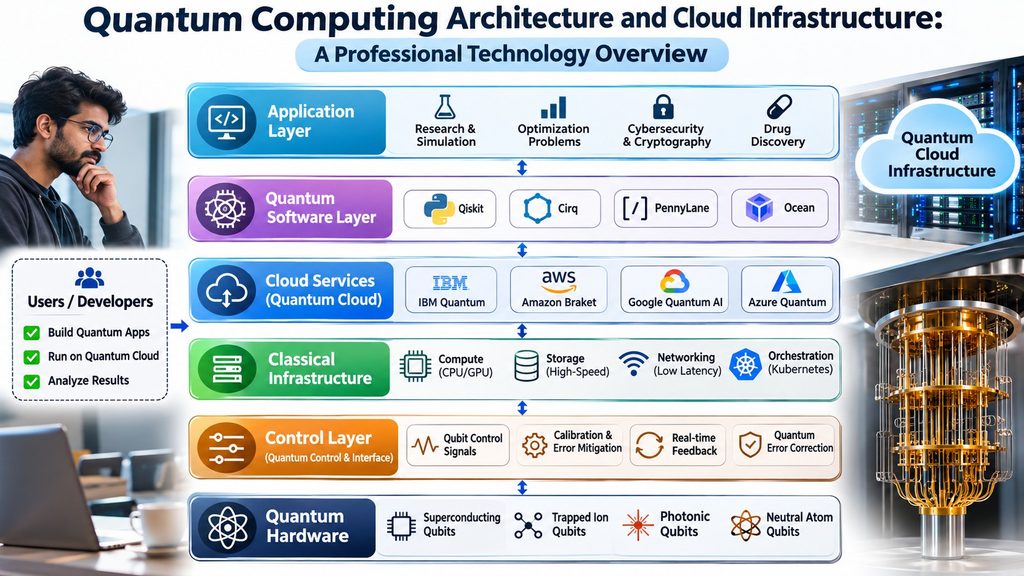
A quantum computing architecture course explains how different components of a quantum computing system work together.
It focuses on system design and technical relationships. Learners study applications, programming frameworks, compilers, control systems, quantum hardware, and classical infrastructure.
3.7.2 Major Architecture Components
1. Application Layer
Defines the problem and prepares the application logic.
2. Programming Framework Layer
Provides tools for creating and representing quantum circuits.
3. Compiler Layer
Transforms circuits into instructions supported by the target system.
4. Control Layer
Supports the operation and control of quantum hardware.
5. Hardware Layer
Contains the physical quantum processing system.
6. Cloud Infrastructure Layer
Provides remote access, resource management, and execution services where applicable.
7. Classical Processing Layer
Handles data preparation, optimisation, control, and results analysis.
8. Measurement Layer
Collects measurement outcomes and returns classical information.
3.7.3 Step-by-Step Learning Process
- Understand the purpose of quantum architecture.
- Review application requirements.
- Study quantum programming frameworks.
- Understand circuit representation.
- Learn compiler and transpiler functions.
- Study logical and physical qubits.
- Understand device connectivity.
- Explore quantum hardware noise.
- Study cloud execution.
- Understand classical processing.
- Design an architecture diagram.
- Document the complete system workflow.
3.7.4 Practical Architecture Project
Design an architecture for a basic quantum application.
Your design should identify:
- Application objectives.
- Programming language.
- Quantum framework.
- Circuit design.
- Compiler or transpiler.
- Simulator or device.
- Execution environment.
- Results processing.
- Security requirements.
- Technical limitations.
Explain how every component contributes to the application.
3.7.5 Professional Applications
Architecture knowledge can support solution architects, system architects, cloud architects, engineering leads, and technical project managers.
3.7.6 Expected Learning Outcome
You should be able to explain the structure of a quantum application and understand its software, hardware, and infrastructure dependencies.
3.8 hybrid quantum classical computing training
3.8.1 What Is Hybrid Quantum Classical Computing Training?
Hybrid quantum classical computing training teaches how classical computers and quantum systems can work together in one workflow.
Classical computers prepare data, adjust parameters, manage calculations, and analyse results. Quantum systems perform the quantum circuit operations.
This combination is important for many experimental quantum algorithms.
3.8.2 Important Learning Areas
- Classical programming fundamentals.
- Quantum circuit design.
- Parameterised quantum circuits.
- Quantum measurements.
- Classical optimisation.
- Iterative algorithms.
- Hybrid architecture.
- Circuit simulation.
- Cloud execution.
- Result processing.
- Error handling.
- Performance evaluation.
3.8.3 Step-by-Step Learning Process
Step 1: Understand classical optimisation.
Study how optimisation methods update parameters to improve an objective function.
Step 2: Learn parameterised circuits.
Understand how circuit operations use adjustable parameters.
Step 3: Build a quantum circuit.
Create a small circuit with adjustable gates.
Step 4: Execute the circuit.
Run it through a simulator or supported device.
Step 5: Collect measurement results.
Retrieve the output for further processing.
Step 6: Calculate the objective value.
Use classical code to analyse the measurements.
Step 7: Update parameters.
Apply an optimisation method to prepare the next circuit.
Step 8: Repeat the process.
Continue until the selected stopping condition is reached.
Step 9: Record experiment data.
Save parameter values, results, and execution details.
Step 10: Compare performance.
Compare the experiment with an appropriate classical baseline.
3.8.4 Examples of Hybrid Algorithms
Variational Quantum Eigensolver: A hybrid algorithm studied for estimating the energy of molecular systems.
Quantum Approximate Optimization Algorithm: A hybrid method studied for combinatorial optimisation problems.
These algorithms are valuable research and learning subjects. Their practical usefulness depends on the problem, hardware, and implementation. They do not guarantee an advantage over classical methods.
3.8.5 Practical Project
Create a parameterised quantum circuit and connect it to a classical optimisation routine. Record the measurement results and objective values after each iteration.
3.8.6 Professional Applications
Hybrid computing knowledge can support algorithm developers, researchers, cloud engineers, data scientists, and quantum software professionals.
3.8.7 Expected Learning Outcome
You should understand how classical programs and quantum circuits interact in iterative computational workflows.
3.9 quantum computing consulting services
3.9.1 What Are Quantum Computing Consulting Services?
Quantum computing consulting services help organisations understand the technology, evaluate technical opportunities, and plan practical experiments.
Consulting can include algorithm assessment, architecture planning, cloud strategy, staff training, prototype development, and risk evaluation.
A responsible consulting process begins with a specific problem. It should not promise that quantum technology will automatically improve business performance.
3.9.2 Major Consulting Areas
- Quantum technology assessment.
- Business problem evaluation.
- Algorithm suitability analysis.
- Quantum cloud strategy.
- System architecture.
- Hybrid workflow development.
- Programming support.
- Training and workshops.
- Proof-of-concept development.
- Security considerations.
- Cost assessment.
- Technical recommendations.
3.9.3 Step-by-Step Consulting Process
Step 1: Understand the organisation.
Review its business objectives and current technical environment.
Step 2: Define the problem.
Convert the requirement into a clear technical question.
Step 3: Review classical solutions.
Understand existing methods and their limitations.
Step 4: Evaluate quantum suitability.
Identify whether relevant quantum algorithms or research approaches exist.
Step 5: Identify technical requirements.
Review data, programming, cloud, hardware, and integration needs.
Step 6: Design the workflow.
Prepare an architecture and execution plan.
Step 7: Estimate costs.
Consider training, development, infrastructure, and testing resources.
Step 8: Build a proof of concept.
Develop a small experiment with clear objectives.
Step 9: Review the results.
Compare measurements and performance with suitable classical methods.
Step 10: Prepare recommendations.
Document results, assumptions, risks, and next steps.
3.9.4 Possible Consulting Deliverables
Depending on the agreed scope, an engagement may produce:
- Technical feasibility report.
- Architecture design.
- Algorithm evaluation.
- Employee training plan.
- Cloud workflow proposal.
- Prototype implementation.
- Cost assessment.
- Risk analysis.
- Final technical recommendations.
3.9.5 Professional Applications
This topic is relevant to technology consultants, enterprise architects, solution designers, research teams, and technical project leaders.
3.9.6 Expected Learning Outcome
You should understand how organisations can evaluate quantum computing projects through evidence, clear requirements, and controlled experimentation.
3.10 quantum computing for IT managers
3.10.1 What Is Quantum Computing for IT Managers?
Quantum computing for IT managers focuses on technology planning, budgeting, team readiness, governance, and project evaluation.
Managers do not need to perform every programming task. However, they should understand the technology well enough to evaluate technical proposals and guide organisational decisions.
They should also understand that quantum computing complements classical computing rather than replacing it for every workload.
3.10.2 Important Management Topics
- Quantum computing fundamentals.
- Business use-case assessment.
- Technology readiness.
- Employee skill requirements.
- Training and development.
- Cloud resource planning.
- Project budgeting.
- Security and governance.
- Technical risk management.
- Vendor evaluation.
- Project milestones.
- Results assessment.
3.10.3 Step-by-Step Management Process
Step 1: Learn the fundamentals.
Understand qubits, quantum gates, algorithms, measurement, and hardware limitations.
Step 2: Identify the business problem.
Select a problem that deserves research or technical evaluation.
Step 3: Review classical alternatives.
Determine whether existing systems already solve the problem effectively.
Step 4: Identify required specialists.
Assess whether the project needs developers, cloud engineers, architects, researchers, or consultants.
Step 5: Prepare a training plan.
Match training activities with team responsibilities.
Step 6: Review infrastructure.
Evaluate cloud access, security permissions, storage, and execution requirements.
Step 7: Prepare the budget.
Estimate training, development, testing, and infrastructure costs.
Step 8: Define milestones.
Establish project objectives, deliverables, and evaluation criteria.
Step 9: Start a limited pilot.
Use a small experiment to examine the proposed approach.
Step 10: Review the outcome.
Compare results with the original objectives and existing classical methods.
3.10.4 Practical Management Example
An organisation wants to evaluate a complex optimisation problem.
The IT manager should ask the technical team to explain the existing solution. The team can then investigate an appropriate quantum approach and design a limited experiment.
The manager should approve a defined scope, budget, and timeline. The final report should explain technical findings, limitations, costs, and comparison results.
3.10.5 Professional Applications
This knowledge can support IT managers, technology directors, project managers, enterprise architects, and digital transformation teams.
3.10.6 Expected Learning Outcome
You should be able to evaluate quantum technology proposals and guide a structured technical pilot.
4. Practical Projects for Quantum Computing Learners
Practical projects help convert theoretical concepts into demonstrable technical skills.
4.1 Project One: Quantum Superposition
Objective: Understand how a Hadamard gate changes a qubit’s state.
Steps:
- Create a development environment.
- Prepare a one-qubit circuit.
- Apply a Hadamard gate.
- Add measurement.
- Execute the circuit using a simulator.
- Collect measurement counts.
- Repeat the experiment.
- Review the outcome distribution.
- Explain the result.
- Document your observations.
Expected Result: Understand superposition and probabilistic measurement.
4.2 Project Two: Quantum Entanglement
Objective: Demonstrate correlations between two qubits.
Steps:
- Create two qubits.
- Apply a Hadamard gate to the first qubit.
- Apply a controlled-NOT gate.
- Measure both qubits.
- Execute the circuit repeatedly.
- Collect measurement results.
- Analyse the outcome relationship.
- Compare results with an ideal simulator.
- Explain the correlation.
- Save the project report.
Expected Result: Understand a basic Bell-state experiment.
4.3 Project Three: Cloud Execution
Objective: Understand remote quantum job management.
Steps:
- Prepare an approved cloud environment.
- Configure the required access.
- Create a simple circuit.
- Test it with a simulator.
- Select a supported execution target.
- Submit the task.
- Monitor its status.
- Collect the output.
- Record execution settings.
- Prepare a technical report.
Expected Result: Understand the workflow of cloud-based quantum experiments.
4.4 Project Four: Hybrid Quantum-Classical Experiment
Objective: Understand interaction between classical code and quantum circuits.
Steps:
- Select an educational optimisation problem.
- Define an objective function.
- Create a parameterised circuit.
- Execute the circuit.
- Collect measurement results.
- Calculate the objective value.
- Update circuit parameters.
- Repeat the experiment.
- Record each iteration.
- Compare it with a classical baseline.
Expected Result: Understand iterative hybrid computing.
5. How to Build a Professional Quantum Computing Portfolio
A portfolio demonstrates your practical knowledge and helps others understand your technical work.
Follow these steps:
- Create a dedicated project repository.
- Separate projects into individual folders.
- Add readable source code.
- Include installation instructions.
- Document project dependencies.
- Add circuit diagrams where useful.
- Explain the objective of each project.
- Include sample results.
- Identify the simulator or backend.
- Explain technical limitations.
- Record important development decisions.
- Update documentation as your skills improve.
A portfolio should explain what you actually tested. An educational project should not be presented as proof of commercial performance or production readiness.
6. A 90-Day Quantum Computing Learning Roadmap
A structured schedule helps learners develop skills in stages. This roadmap assumes regular learning and practical exercises.
6.1 Days 1–15: Build the Fundamentals
- Day 1: Introduction to quantum computing.
- Day 2: Understand bits and qubits.
- Day 3: Learn quantum states.
- Day 4: Study superposition.
- Day 5: Understand entanglement.
- Day 6: Learn measurement.
- Day 7: Review basic concepts.
- Day 8: Study vectors.
- Day 9: Practise matrix operations.
- Day 10: Understand probability.
- Day 11: Learn complex numbers.
- Day 12: Study quantum gates.
- Day 13: Practise circuit diagrams.
- Day 14: Create simple circuit designs.
- Day 15: Complete a fundamentals exercise.
6.2 Days 16–30: Learn Python and Qiskit
- Day 16: Install Python.
- Day 17: Configure your development environment.
- Day 18: Learn Python variables.
- Day 19: Practise lists and dictionaries.
- Day 20: Study Python functions.
- Day 21: Install Qiskit.
- Day 22: Create your first circuit.
- Day 23: Practise the Hadamard gate.
- Day 24: Learn the Pauli-X gate.
- Day 25: Study the controlled-NOT gate.
- Day 26: Add measurements.
- Day 27: Run a simulator.
- Day 28: Analyse measurement results.
- Day 29: Create a Bell-state circuit.
- Day 30: Complete your first project.
6.3 Days 31–45: Develop Programming Skills
- Day 31: Revise quantum programming.
- Day 32: Understand quantum registers.
- Day 33: Study circuit depth.
- Day 34: Practise gate combinations.
- Day 35: Learn circuit visualisation.
- Day 36: Understand transpilation.
- Day 37: Study hardware connectivity.
- Day 38: Explore backend selection.
- Day 39: Compare simulation configurations.
- Day 40: Practise circuit testing.
- Day 41: Learn debugging.
- Day 42: Study quantum algorithms.
- Day 43: Explore Grover’s algorithm.
- Day 44: Review programming exercises.
- Day 45: Complete a programming project.
6.4 Days 46–60: Study Quantum Cloud Computing
- Day 46: Understand quantum cloud computing.
- Day 47: Study remote execution.
- Day 48: Explore cloud quantum services.
- Day 49: Learn access management.
- Day 50: Study quantum simulators.
- Day 51: Understand notebook environments.
- Day 52: Create a cloud-ready circuit.
- Day 53: Run a simulation.
- Day 54: Learn task submission.
- Day 55: Study execution monitoring.
- Day 56: Retrieve results.
- Day 57: Explore different development environments.
- Day 58: Understand hybrid execution.
- Day 59: Compare cloud workflows.
- Day 60: Complete a cloud experiment.
6.5 Days 61–75: Learn Architecture and Hybrid Systems
- Day 61: Study quantum architecture.
- Day 62: Understand application components.
- Day 63: Explore programming frameworks.
- Day 64: Learn compiler operations.
- Day 65: Study physical qubit mapping.
- Day 66: Understand device connectivity.
- Day 67: Explore quantum noise.
- Day 68: Study error correction.
- Day 69: Understand hybrid computing.
- Day 70: Learn parameterised circuits.
- Day 71: Study classical optimisation.
- Day 72: Explore VQE.
- Day 73: Explore QAOA.
- Day 74: Design an architecture diagram.
- Day 75: Complete an architecture exercise.
6.6 Days 76–90: Complete Projects and Career Preparation
- Day 76: Select your final project.
- Day 77: Define the project objective.
- Day 78: Design your circuit.
- Day 79: Run simulator tests.
- Day 80: Collect measurement results.
- Day 81: Analyse technical limitations.
- Day 82: Compare classical alternatives.
- Day 83: Prepare project documentation.
- Day 84: Organise source code.
- Day 85: Review certification options.
- Day 86: Practise interview questions.
- Day 87: Prepare your project explanation.
- Day 88: Review your technical skills.
- Day 89: Identify advanced learning topics.
- Day 90: Prepare your next learning plan.
Expected Outcome: This roadmap can help you build foundational knowledge, practise quantum programming, understand cloud execution, and complete beginner-level projects. Advanced expertise requires continued study and professional experience.
7. Quantum Computing Career Paths
Different career paths require different combinations of technical skills.
7.1 Quantum Software Developer
Focus on programming frameworks, circuit development, algorithms, testing, and simulation.
7.2 Quantum Cloud Engineer
Focus on infrastructure, access permissions, remote execution, job management, and cloud resources.
7.3 Quantum Solutions Architect
Focus on system design, hardware constraints, application workflows, and integration requirements.
7.4 Quantum Research Engineer
Focus on algorithm research, mathematical modelling, simulation, and experimentation.
7.5 Quantum Technology Consultant
Focus on technology assessment, technical planning, proof-of-concept development, and project evaluation.
7.6 Quantum Technology Manager
Focus on project planning, budgets, governance, skills development, and organisational readiness.
Actual responsibilities vary across employers. Review job requirements before choosing a career direction.
8. Common Mistakes to Avoid
- Starting advanced quantum algorithms too early.
- Ignoring mathematics and probability.
- Copying code without understanding it.
- Trying to learn multiple frameworks simultaneously.
- Assuming simulators always represent physical hardware accurately.
- Ignoring device connectivity and noise.
- Overlooking cloud permissions and costs.
- Treating every certificate as an accredited qualification.
- Assuming quantum computers replace classical computers.
- Claiming performance advantages without sufficient testing.
Focus on understanding one concept at a time. Regular practice will help you develop stronger technical knowledge.
9. Frequently Asked Questions
9.1 What is quantum cloud computing training?
Quantum cloud computing training teaches professionals how to access simulators and supported quantum devices remotely. It includes circuit development, authentication, task submission, execution monitoring, and results analysis. It also covers permissions, device availability, and resource management.
9.2 What does a quantum computing certification course include?
A certification course may cover quantum fundamentals, mathematics, quantum circuits, algorithms, programming frameworks, and simulations. Advanced programmes may include cloud execution, architecture, hardware, and hybrid workflows. The actual syllabus depends on the training provider.
9.3 What is QuantumOps certification?
QuantumOps certification is a professional learning topic associated with quantum computing engineering, operations, architecture, and management. Learners should review the individual programme, its assessment method, issuing organisation, and any independently verified recognition.
9.4 Why should software developers learn Qiskit?
Qiskit provides tools for creating and analysing quantum circuits. Python developers can practise quantum gates, measurements, circuit operations, and transpilation. These activities provide practical experience with quantum software development.
9.5 What does AWS Braket training teach?
AWS Braket training can cover circuit development, simulator execution, remote task submission, supported hardware access, and result collection. It can also introduce hybrid jobs and cloud resource management. Learners should understand service costs and access restrictions.
9.6 Is quantum computing useful for software engineers?
Quantum computing provides software engineers with another technical field to explore. Their Python, debugging, testing, and documentation skills remain useful. They must also learn quantum states, circuits, measurement, and hardware limitations.
9.7 What is included in quantum computing architecture training?
Architecture training covers applications, frameworks, compilers, logical and physical qubits, device connectivity, cloud infrastructure, and measurement processing. It explains how classical and quantum components work together.
9.8 What is hybrid quantum classical computing?
Hybrid quantum classical computing combines classical processing with quantum circuit execution. Classical programs prepare data, update parameters, and analyse results. Quantum simulators or devices perform the required circuit operations.
9.9 What do quantum computing consulting services provide?
Consulting services may include technology assessments, algorithm evaluation, architecture planning, cloud strategy, training, and prototype development. A responsible engagement defines objectives and compares experiments with classical alternatives.
9.10 How can IT managers prepare their teams for quantum computing?
IT managers can start with fundamental training and role-based learning. They should identify relevant problems, assess team skills, estimate costs, review security, and define clear evaluation criteria for technical experiments.
10. Final Thoughts
Quantum computing combines mathematics, programming, algorithms, cloud infrastructure, and system architecture. Professionals can explore these areas through different learning paths that match their technical backgrounds and career objectives.
The ten topics in this guide provide a structured approach to developing practical knowledge. Begin with the fundamentals, practise programming, understand cloud execution, and gradually explore architecture and hybrid workflows.
Build small projects and document your results. Learn from unsuccessful experiments and understand the limitations of current technology. This practical approach will help you build stronger skills and make informed professional decisions.
Leave a Reply