Explore Pilot and Astronaut Careers Step by Step
Introduction
A career in aviation or space exploration starts with curiosity. Some people want to fly passenger aircraft. Others want to study space and support human missions beyond Earth. Both paths require careful planning, strong technical skills, and ongoing learning.
You do not need to make every career decision today. First, understand what each profession involves. Then explore the education, medical standards, training, and qualifications required. This guide explains the main steps involved in pilot and astronaut career preparation. It also covers flight simulation and basic space science. These details can help students make informed choices and plan their next steps.
1. How to Become an Airline Pilot
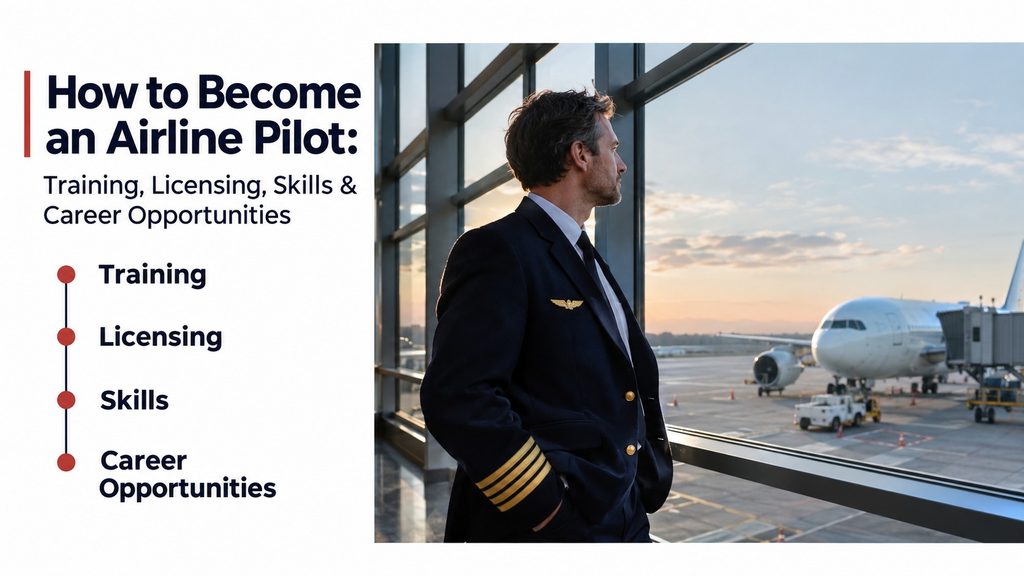
An airline pilot operates aircraft and helps transport passengers or cargo. The role involves much more than controlling an aircraft. Pilots plan flights, review weather, follow procedures, and communicate with air traffic control.
The exact pathway depends on the country and aviation authority. The following steps describe a common professional route.
Step 1: Understand the Career
Before paying for training, learn about the daily work. Airline pilots follow schedules and operating procedures. They must remain alert and make careful decisions.
The job also involves responsibility for passengers, crew, and aircraft. Irregular working hours and time away from home may be part of the career.
Step 2: Check Education and Eligibility
Complete the education required by your chosen training route. Mathematics, physics, and English can provide a useful foundation.
A university degree is not a universal requirement for pilot licensing. However, individual airlines may set additional recruitment criteria.
Step 3: Check Medical Standards
Aviation medical fitness is an important part of pilot eligibility. The required medical certificate depends on the license and country.
Arrange an assessment with an authorized aviation medical examiner. This can help identify eligibility concerns before you commit to expensive training.
Step 4: Start Flight Training
Many professional pathways begin with private pilot training. Students learn aircraft controls, navigation, communication, weather, and safety.
They gradually develop the skills needed for independent flying.
Step 5: Earn Professional Qualifications
After the initial stage, candidates may pursue a Commercial Pilot License. Additional ratings and flight experience may also be necessary.
The required qualifications depend on the aircraft and intended operation.
Step 6: Build Experience and Apply
Airline employers often require more than a commercial license. Candidates may need advanced qualifications and substantial flight experience.
Prepare your records and review each airline’s recruitment requirements. Selection may include interviews, technical tests, and simulator assessments.
Practical tip: Compare several training providers before enrolling. Ask for a complete fee breakdown, training schedule, and details about aircraft availability.
2. Private Pilot License Requirements
A Private Pilot License (PPL) introduces students to practical aircraft operations. It provides a foundation for personal flying and further pilot training.
The requirements vary between aviation authorities. Always check the rules for the country where you intend to train.
Age and Eligibility
Minimum age requirements depend on the license category and country.
For an FAA airplane private pilot certificate, the general minimum age is 17. Applicants must also satisfy applicable language and other eligibility requirements.
Medical Requirements
Applicants must meet the medical or eligibility standards that apply to their certificate.
The type of medical approval can vary. Confirm the requirements before beginning flight training.
Ground School
Ground school teaches the knowledge needed for safe flying.
Common subjects include:
- Aviation regulations.
- Aircraft systems.
- Weather reports and forecasts.
- Flight planning.
- Navigation.
- Radio communication.
- Aerodynamics.
- Emergency procedures.
Students should understand these subjects rather than simply memorize answers.
Practical Flight Lessons
Flight lessons help students apply classroom knowledge. They learn how to control an aircraft in different situations.
Training commonly includes takeoffs, landings, turns, climbs, descents, and navigation exercises.
Under the standard FAA Part 61 airplane pathway, applicants need at least 40 flight hours. This includes specified instructor-led and solo experience.
Many students require additional hours before they meet the required standard.
Knowledge and Practical Tests
Applicants must pass the required knowledge examination. They must also demonstrate their flying ability during a practical test.
The examiner checks aircraft control, procedures, and decision-making.
What Happens After Getting a PPL?
A PPL allows flying within the privileges and limitations of the certificate. It can also prepare students for advanced training.
However, it does not generally authorize paid commercial flying. Additional qualifications are needed for professional operations.
3. Commercial Pilot License Requirements
A Commercial Pilot License (CPL) is designed for pilots who want to perform eligible flying duties for compensation or hire.
It requires more advanced knowledge and flying ability than a private certificate. The exact requirements depend on the country and aircraft category.
Eligibility and Medical Standards
Candidates must meet the applicable minimum age requirements. They must also satisfy medical standards for the intended privileges.
Some professional flying roles require a higher level of medical certification. Check this before choosing a training route.
Flight Experience
Commercial candidates need substantial flight experience. They must complete the required training and demonstrate the necessary skills.
For a standard FAA Part 61 airplane single-engine commercial certificate, the general minimum is 250 total flight hours.
Specific experience requirements also apply. Certain approved training pathways have different minimums.
Advanced Flying Skills
Commercial students develop more precise aircraft control. They learn to manage performance, navigation, and operational risks.
Training may include:
- Advanced aircraft maneuvers.
- Cross-country flying.
- Performance planning.
- Emergency procedures.
- Weather decision-making.
- Commercial operating rules.
- Navigation techniques.
- Aircraft systems knowledge.
Examinations
Candidates must complete the applicable knowledge and practical examinations.
The practical test assesses whether they can operate safely. It also checks their ability to apply aviation knowledge.
Career Options
A CPL can support several types of professional flying, depending on ratings and experience.
Possible areas include:
- Charter operations.
- Aerial photography.
- Survey flying.
- Agricultural aviation.
- Flight instruction.
- Other approved commercial operations.
An airline career may require further qualifications and experience. A CPL alone does not guarantee airline employment.
4. Pilot Training Programs in the USA
The United States has several training routes for people interested in aviation. Students can choose a training structure based on their schedule and career plans.
Understanding the differences can help avoid unnecessary costs.
Part 61 Training
Part 61 offers flexibility in how students complete their flight training.
Students may arrange lessons around work, education, or personal responsibilities. Training can take place with eligible instructors and flight schools.
This route may suit people who need a flexible schedule.
What to check:
- Instructor availability.
- Aircraft access.
- Lesson frequency.
- Training records.
- Total expected cost.
- School safety practices.
Part 141 Training
Part 141 schools follow FAA-approved training courses and syllabuses.
The program uses defined stages and training procedures. Certain approved courses may qualify students for different minimum-hour pathways.
However, the rules depend on the specific program and certificate.
Do not select a school only because it offers Part 141 training. Compare its instructors, aircraft, facilities, and student support.
University-Based Aviation Training
Some universities offer aviation degrees alongside flight training.
This route may appeal to students who want academic study and professional aviation preparation together.
Review the program carefully. Check the qualifications included, additional costs, and graduation requirements.
Questions to Ask Before Enrolling
Speak with the school’s admissions team and instructors. Ask for clear answers about the training process.
Important questions include:
- What licenses does the program cover?
- Which costs are included in the quoted fee?
- Are aircraft rental and instructor fees separate?
- How often can students fly?
- What happens when aircraft are unavailable?
- Are written tests and practical tests included?
- What support is available after graduation?
Plan for Additional Costs
Training expenses may include aircraft rental, instructor time, medical examinations, equipment, and testing fees.
Extra lessons may increase the final cost. Keep a financial reserve for delays and additional training.
International students should also check visa conditions and work authorization. Training permission does not automatically provide permission to work.
5. Airline Transport Pilot License Requirements
The Airline Transport Pilot License (ATPL) is an advanced pilot qualification. It is associated with the highest level of pilot certification in many professional licensing systems.
The exact requirements differ between countries.
Flight Experience
Under the standard FAA airplane ATP pathway, applicants generally need 1,500 total flight hours.
Some eligible applicants may qualify for a Restricted ATP certificate. This option has specific education and experience conditions.
Applicants should check their eligibility carefully. A reduced-hour pathway is not available to everyone.
Knowledge and Practical Assessments
ATP candidates must demonstrate advanced aviation knowledge. They also need to meet the applicable practical testing standards.
Preparation may cover:
- Advanced aircraft systems.
- Flight planning.
- Weather analysis.
- Crew resource management.
- Operational procedures.
- Navigation.
- Safety management.
- Emergency decision-making.
ATP Certification Training Program
Certain multiengine airplane ATP applicants must complete an ATP Certification Training Program (ATP CTP) before taking the applicable knowledge test.
Check the current FAA rules for the certificate you intend to pursue.
Why Do Airlines Value Advanced Qualifications?
Advanced qualifications demonstrate that a pilot has met demanding standards.
However, airlines also consider other factors. These may include experience, aircraft qualifications, training performance, and recruitment needs.
How to Prepare
Keep accurate flight records from the beginning of your career. Review your progress against official requirements.
Choose training providers carefully. Confirm that each course meets the applicable regulatory standard.
For current U.S. requirements, consult the FAA’s official ATP guidance.
6. How to Become an Astronaut
Astronauts support human spaceflight and scientific missions. Their work can involve spacecraft operations, experiments, equipment checks, and mission planning.
Astronaut selection is competitive. Different space agencies use different eligibility rules.
Build a Relevant Education
Start by developing a strong academic foundation. Many astronaut candidates study technical or scientific subjects.
Relevant fields can include:
- Aerospace engineering.
- Mechanical engineering.
- Electrical engineering.
- Computer science.
- Physics.
- Mathematics.
- Biological sciences.
- Medicine.
A particular degree does not guarantee selection. Review the education requirements of your target agency.
Gain Professional Experience
Space agencies often look for candidates with relevant professional experience.
This may come from engineering, research, medicine, aviation, or other specialist work.
Develop the ability to solve problems and work with complex systems. Seek opportunities that build responsibility and practical knowledge.
Develop Physical and Mental Readiness
Space missions can involve demanding conditions. Astronauts must work safely in unfamiliar environments.
Selection processes may include medical assessments and other evaluations. The standards depend on the agency and mission role.
Build Teamwork Skills
Astronauts work with many specialists. They must communicate clearly and cooperate during difficult tasks.
Practice working in teams. Learn to explain technical information in simple language.
Understand Agency Requirements
Do not assume that one country’s astronaut rules apply everywhere.
For example, NASA’s current selection requirements include U.S. citizenship, specific education and experience standards, and a long-duration flight physical.
Other agencies may have different citizenship and qualification rules.
Prepare for Selection
Follow official recruitment announcements. Read the eligibility criteria before applying.
Keep records of your education, work experience, projects, and achievements. Prepare examples that demonstrate leadership and problem-solving.
7. Astronaut Training for Students
Students can begin exploring space careers at an early age. They can build useful skills through school subjects and practical projects.
The aim is to develop curiosity and a strong technical foundation.
Learn Mathematics and Physics
Mathematics supports measurement, calculations, and problem-solving.
Physics helps explain motion, energy, forces, and gravity. These ideas are important in aerospace engineering and space science.
Explore Computer Science
Modern spacecraft depend on software and electronic systems.
Students can learn basic programming. They can also explore robotics, sensors, and simple automation projects.
Try Practical Science Activities
Small projects can make technical subjects easier to understand.
Consider these ideas:
- Build a model of the solar system.
- Create a simple weather-monitoring project.
- Program a small robot.
- Study satellite images.
- Make a basic model of a spacecraft.
- Explore safe, supervised model rocketry activities.
Follow safety rules and use proper supervision.
Learn About Space Missions
Read about different types of space missions. Understand the purpose of satellites, space telescopes, crewed spacecraft, and robotic explorers.
Try to explain how each mission works. This develops research and communication skills.
Develop a Project Portfolio
Keep a record of your work. Include project notes, diagrams, photographs, and presentations.
A portfolio can help you review your progress. It may also support future academic or professional applications.
Look Beyond the Astronaut Role
Space missions need many types of professionals. Engineers, software developers, scientists, doctors, and mission controllers all contribute.
Students should explore these roles too. They offer different ways to work in the space sector.
8. Pilot Training vs Astronaut Training
Pilot training and astronaut training share several skills. Both require technical knowledge, discipline, teamwork, and careful decisions.
However, their goals and working environments differ.
Training Objectives
Pilot training prepares people to operate aircraft. Students learn flight controls, navigation, communication, and aviation procedures.
Astronaut training prepares selected candidates for space missions. It can include spacecraft systems, science experiments, robotics, and survival.
Education Requirements
Pilot licensing usually focuses on aviation training and regulatory requirements. A university degree is not always necessary.
Astronaut selection often requires advanced education or relevant professional experience. Each agency defines its own standards.
Practical Training
Pilots train in aircraft and simulators. They practice flight operations and emergency procedures.
Astronauts train in mission-related environments. Their preparation may include spacecraft mock-ups, underwater exercises, robotics, and scientific tasks.
Work Environment
Pilots generally operate aircraft in Earth’s atmosphere. Their work may involve passenger, cargo, private, or specialist operations.
Astronauts work in spaceflight environments and mission preparation facilities. Their duties depend on the mission.
Shared Professional Skills
Both careers benefit from:
- Clear communication.
- Situational awareness.
- Problem-solving.
- Teamwork.
- Technical knowledge.
- Stress management.
- Safety awareness.
Which Path Fits Your Interests?
Aviation may suit people who enjoy aircraft operations and practical flying.
Space careers may suit people who enjoy science, research, engineering, and exploration.
You do not need to decide immediately. Study both areas and identify which activities interest you most.
9. Spaceflight Basics for Beginners
Spaceflight involves sending vehicles beyond Earth’s atmosphere and controlling their movement in space.
It uses physics, engineering, mathematics, and computer systems. Learning a few basic concepts makes the subject easier to understand.
Rockets and Thrust
A rocket engine produces thrust by expelling exhaust gases. The vehicle moves in the opposite direction.
This is an example of Newton’s third law of motion. Rockets can operate in space because they carry the material needed for their propulsion.
Gravity and Orbital Motion
Gravity attracts objects toward one another. It plays a major role in the movement of planets, moons, and spacecraft.
An orbit occurs when an object follows a continuous path around another body. A spacecraft in orbit is moving forward while gravity continually changes its direction.
Understanding Microgravity
Astronauts in an orbiting spacecraft experience apparent weightlessness.
The spacecraft and its occupants are in continuous free fall around Earth. This creates conditions where objects appear to float.
Spacecraft Systems
A spacecraft needs several systems to operate safely.
These can include:
- Power generation and storage.
- Communication equipment.
- Navigation systems.
- Thermal control.
- Life-support systems.
- Computers and onboard software.
Each system has a specific purpose. Many systems work together during a mission.
Ground Control and Communication
Mission control teams monitor spacecraft operations from Earth. They receive data and send instructions.
Communication systems help teams understand spacecraft performance. They also support mission planning and problem-solving.
Types of Space Missions
Space missions have different goals. Some observe Earth, while others study planets, stars, or the Sun.
Crewed missions carry astronauts. Robotic missions use spacecraft and instruments without onboard human crews.
Learning these differences provides a useful starting point for space science.
10. Best Flight Simulator Software for Student Pilots
Flight simulation software can help students explore aircraft operations. It provides a virtual environment for learning cockpit layouts and basic flying concepts.
It can also support discussions with instructors. However, home simulation does not automatically count toward official flight-hour requirements.
Here are three established options to research.
1. Microsoft Flight Simulator
Microsoft Flight Simulator is a consumer flight simulation platform.
It can help beginners explore virtual aircraft operations. Students can use it to become familiar with cockpit layouts and general flight concepts.
Features:
- Virtual aircraft environments.
- Cockpit-based interaction.
- Visual flight practice.
- Flight planning activities.
Pros:
- Accessible to many flight simulation enthusiasts.
- Useful for general familiarization.
- Offers an engaging visual environment.
Cons:
- Requires suitable computer hardware.
- Does not replace real flight lessons.
- Available features vary by edition and setup.
2. X-Plane
X-Plane is a flight simulation platform used by enthusiasts and some training environments.
It can support aircraft familiarization and simulation practice. Its suitability depends on the selected aircraft and setup.
Features:
- Aircraft simulation.
- Virtual cockpit environments.
- Flight control practice.
- Configurable simulation setups.
Pros:
- Useful for exploring aircraft behavior.
- Supports different simulation needs.
- Can complement classroom learning.
Cons:
- Some setups require technical knowledge.
- Hardware requirements can vary.
- It cannot replace approved flight instruction.
3. Prepar3D
Prepar3D is a simulation platform used in some professional and educational settings.
Its intended use and licensing should be reviewed before purchase.
Features:
- Configurable simulation environments.
- Aviation training scenarios.
- Support for specialized setups.
- Virtual aircraft operations.
Pros:
- Can support structured simulation activities.
- Offers configurable environments.
- May suit specialized training installations.
Cons:
- Setup may need technical support.
- Hardware needs depend on configuration.
- Licensing terms should be checked.
How to Select the Right Simulator
Choose software based on your learning goals. Beginners may want basic cockpit familiarization. More advanced students may need a setup recommended by their instructors.
Compare these factors:
- Software cost.
- Computer requirements.
- Available aircraft.
- Ease of installation.
- Learning resources.
- Hardware compatibility.
- Instructor recommendations.
Do not use simulation to replace real flight training. Follow your instructor’s procedures and the rules of your aviation authority.
Frequently Asked Questions
1. What should I study to become an airline pilot?
Study subjects that build mathematics, physics, and English skills. Then research the licensing pathway in your country. Flight training and medical eligibility are also important.
2. Is a PPL the first step toward a commercial pilot career?
It is a common starting point, but training pathways vary. Some students follow integrated or other approved programs. Check the requirements of your chosen aviation authority.
3. How many hours are required for an FAA commercial pilot certificate?
The standard FAA Part 61 airplane single-engine pathway generally requires 250 total flight hours. Specific training and experience conditions also apply.
4. Are Part 61 and Part 141 training the same?
No. They follow different regulatory training structures. Part 61 offers flexibility, while Part 141 uses FAA-approved syllabuses.
5. Does an ATP certificate guarantee an airline job?
No. An ATP is an advanced qualification, but airlines have their own hiring standards. Experience, recruitment needs, and selection performance also matter.
6. Can someone become an astronaut without being a pilot?
Yes. Astronaut candidates can come from several professional backgrounds. Engineering, science, medicine, and other relevant fields can provide suitable experience.
7. What skills should students develop for space careers?
Students should build science, mathematics, communication, and problem-solving skills. Programming and teamwork can also be useful.
8. Do all space agencies follow NASA’s astronaut requirements?
No. Each space agency sets its own eligibility rules. Applicants should check the official requirements of their target agency.
9. Can flight simulators help before joining a flight school?
Yes. They can introduce basic aircraft concepts and cockpit layouts. However, they do not replace formal instruction or official flight-hour requirements.
10. Which is better: an aviation career or a space career?
Neither is universally better. The right choice depends on your interests, qualifications, and long-term goals. Research both fields before deciding.
Conclusion
Pilot and astronaut careers require different types of preparation. Both demand technical knowledge, discipline, and a strong focus on safety.
Start by learning the official requirements. Compare training routes and understand the costs. Build relevant skills through education and practical projects.
If you want to fly aircraft, explore the licensing pathway in your country. If space exploration interests you, study science and engineering opportunities. You can also explore related careers in software, research, and aerospace technology.
Keep learning and make decisions based on reliable information. AstroPilot – Astronaut & Pilot offers informational resources to help readers explore aviation and space topics.
Explore aviation, pilot training, and space education:
Leave a Reply